
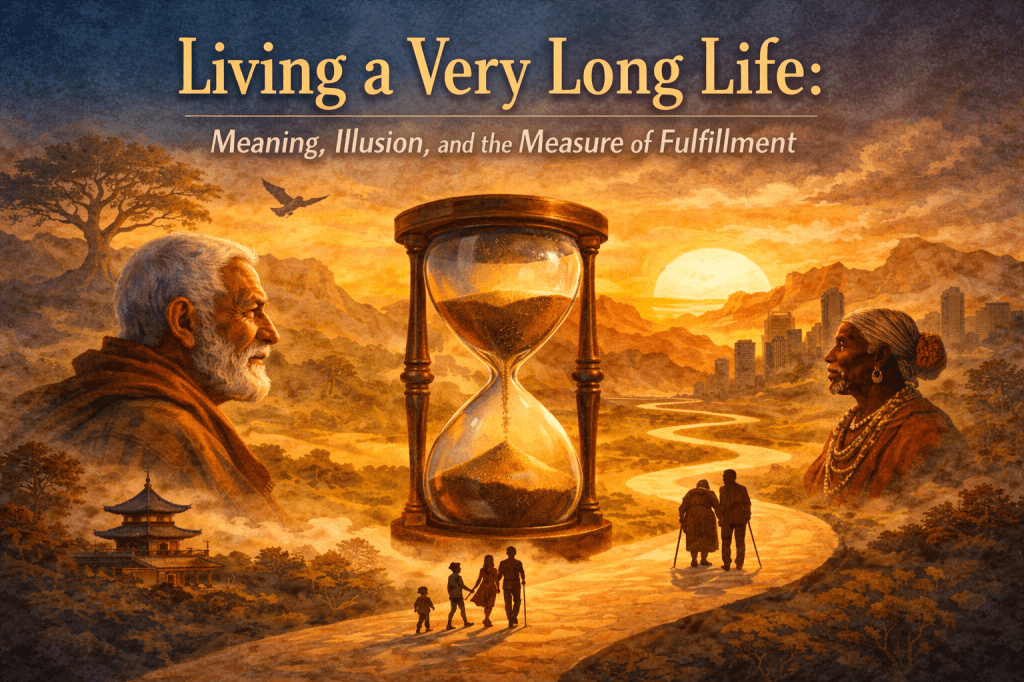
A Reflection on Longevity, Culture, and the True Purpose of Time.
Introduction
Across generations, wisdom has quietly reminded humanity that length of days is not the same as depth of life. From ancient proverbs to modern philosophy, thoughtful minds have long agreed that time alone does not confer meaning; rather, meaning is cultivated through how time is lived. The idea of living a very long life often carries with it hope, fear, ambition, and comfort all at once. Yet wisdom urges us to pause and ask a deeper question: what is the true value of longevity if it is not accompanied by purpose, contribution, and inner peace?
Understanding the Concept of Living a Very Long Life
Living a very long life entails more than biological survival or medical advancement. It encompasses physical health, mental resilience, emotional maturity, social relevance, and spiritual grounding. In today’s world, longevity is often framed as a triumph of science, wealth, and technology, where extended years are seen as proof of progress. However, life extended without meaning can quietly become repetitive, hollow, or burdensome, both to the individual and to society.
From a global perspective, different cultures and societies interpret long life in distinct ways. In many African societies, longevity is deeply associated with wisdom, ancestral continuity, and communal leadership. Elders are valued not merely for their age but for their lived experiences, moral authority, and role in guiding younger generations. In East Asian cultures, long life is closely tied to harmony, discipline, balance, and respect for nature, with aging viewed as a gradual refinement of character. Western societies often approach longevity through productivity, independence, and personal achievement, sometimes measuring life’s worth by sustained economic or social relevance.
Despite these differences, a common thread exists across cultures: a long life is only celebrated when it remains meaningful, dignified, and socially connected.
A Personal Reflection on Longevity
My thoughts on the concept of living a very long life are shaped by both realism and reflection. It appears to be nothing more than a long term satisfactory illusion, one that promises fulfillment simply through extended time, yet remains temporal and fragile when viewed from a broader perspective. Life itself can be deeply enjoyable, filled with beauty, love, creativity, and discovery. However, enjoyment alone does not guarantee fulfillment.
When longevity becomes the ultimate goal, it risks distracting us from the urgency of living well in the present. A very long life may offer more opportunities, but it also amplifies unresolved struggles, unmet purpose, and unexamined values. Without intentional growth, contribution, and self awareness, extended years may merely stretch the same cycles of desire, disappointment, and routine.
In a broader sense, life is temporary regardless of its length. Whether one lives forty years or a hundred, the essence of existence remains transient. What endures is not the number of years lived, but the impact made, the values upheld, and the lives touched along the way.
Longevity Versus Legacy
Rather than asking how long we will live, perhaps the more meaningful question is how well we will live. A shorter life lived with clarity, service, and integrity may outweigh a longer life spent chasing comfort without purpose. True fulfillment arises when time is aligned with meaning, when personal growth is matched with social contribution, and when enjoyment is balanced with responsibility.
Living a very long life should therefore not be pursued as an end in itself, but as a possibility that gains value only when anchored in wisdom, humility, and intentional living. Longevity without depth is fragile. Depth, even within limited time, is powerful.
In short, the concept of living a very long life invites admiration, curiosity, and caution. Across cultures and societies, it is clear that time alone does not define a good life. Meaning does. A long life can be a gift, but only when it is lived with awareness, purpose, and service. Otherwise, it remains a comforting illusion, satisfying in theory yet fleeting in substance.
Closing Note
Thank you to the platform and the wider community for creating a space where thoughtful reflection, shared perspectives, and meaningful engagement are encouraged. Your continued dialogue and participation make conversations like this richer and more impactful.
#godemarsempire | @aikinannu

Leave a comment