
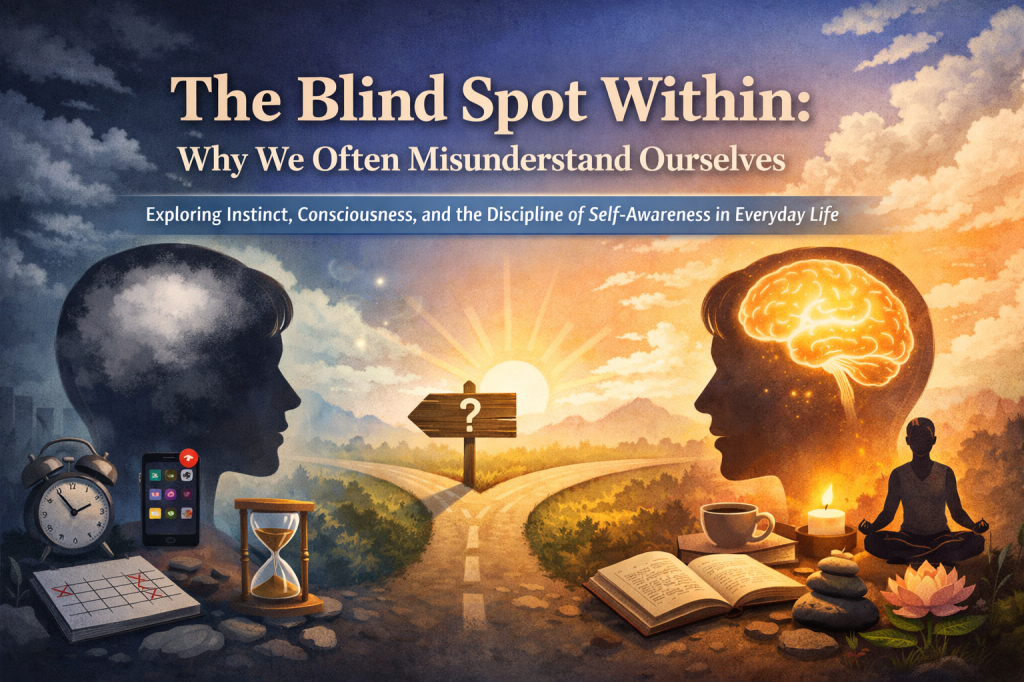
Exploring Instinct, Consciousness, and the Discipline of Self-Awareness in Everyday Life
Pause for a moment.
Before we look outward and question the world, it’s worth asking: how well do we truly understand ourselves?
One of the most overlooked truths is that misunderstanding often begins internally. People frequently assume that confusion comes from external complexity; society, systems, or other people. But in reality, a significant part of our lack of understanding is rooted in how we process our own thoughts, emotions, and decisions.
At the core of human consciousness lies a powerful yet subtle force: personal instinct. Instinct can serve as a guiding signal; an inner awareness that prompts reflection, self-critique, and adjustment. When properly engaged, it awakens a person to question their actions, refine their behavior, and ultimately avoid misunderstanding both themselves and their environment.
However, instinct has a dual nature.
While it can elevate awareness, it can also operate as a state of subconsciousness; one that bypasses deliberate thinking. In this state, instinct does not question; it reacts. It promotes comfort over clarity, repetition over reflection, and assumption over understanding. When instinct functions without conscious oversight, it suppresses self-critique, and this is where misunderstanding begins to take root.
This lack of self-critique often places individuals in avoidable conditions; misjudged decisions, strained relationships, missed opportunities, and cycles of unproductive habits. The implications can be subtle at first, but over time they compound into patterns that shape one’s life direction. People may not even realize they are operating unconsciously, because the behavior feels “natural.”
So, what can be done?
The remedy lies in holistic practices that reconnect instinct with awareness:
- Mindful reflection: Creating space to question your thoughts and actions regularly
- Intentional living: Acting with purpose rather than impulse
- Time discipline: Structuring your day to reduce chaos and distractions
- Rest and recovery: Allowing the mind to reset and function clearly
- Learning and exposure: Engaging with knowledge that challenges your assumptions
These practices help transform instinct from a reactive force into a refined tool for conscious living.
On a personal note, I’ve observed how easily unconsciousness can set in under certain conditions. When sleep deprivation creeps in and time wasting becomes normalized, I tend to lose a level of awareness. In those moments, I become less intentional; more drawn to distractions that offer little value. It’s a subtle shift, but one that affects clarity, decision-making, and productivity.
For me, two simple yet powerful remedies stand out:
sleep and proper time planning.
Adequate rest restores mental sharpness, while structured time creates a framework for intentional action. Together, they support conscious thinking and reduce the likelihood of drifting into unconscious patterns.
In short, what most people don’t understand is not always something external; it is often the internal mechanisms that shape how we think, act, and interpret life. By becoming more aware of our instincts and cultivating self-critique, we move closer to true understanding; not just of the world, but of ourselves.
Thank You Note
Thank you to this platform and the entire community for creating a space where such reflections can be shared and explored. Your engagement, thoughts, and perspectives continue to deepen these conversations.
#godemarsempire | @aikinannu

Leave a comment